Musician Fonotī Pati Umaga on living with paralysis: 'We're unbelievable people'
In a new theatre show, the former Holidaymakers bass player shares his own story with honesty and humour.

Forced by his father to learn bass guitar so he could play in a family church band, Fonotī Pati Umaga later joined the Wellington band Holidaymakers, performing on their number-one 1988 hit 'Sweet Lovers' - a Bill Withers cover.
Fast-forward to 2005, and he was living in Auckland, project-managing for the Pasifika Festival, running a record label, and thinking he was "going places". Then a sudden fall in the bathroom left him a tetraplegic.
Umaga talks to Summer Weekends about coming through some "dark years" to perform in the autobiographical show Music Portrait of A Humble Disabled Samoan.
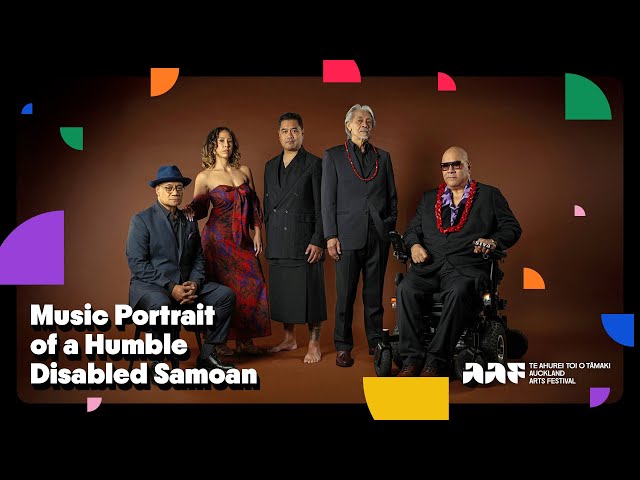
After growing up in Wainuiomata with his brothers - and rugby-playing cousin Tana - Umaga now lives in the Wellington suburb of Naenae.
Weekday mornings, he can be seen "burning down to the railway station" in his wheelchair to catch the train to his job as a senior advisor to the New Zealand Royal Commission of Inquiry into Abuse iIn State Care.
After Umaga's accident put him in a wheelchair 20 years ago, he says he went into a "deep dive" of depression, addiction, and just thinking his life was over.

Fonoti Pati Umaga - Music Portrait of a Humble Disabled Samoan
When you suddenly become disabled, there's a lot of "stereotyping" in your head that has a depressing effect, he says.
In Samoan culture, historically, there's also been lots of stigma towards disabled people, with people in the past viewing it as a curse or an embarrassment to the family.
Althoigh these "extreme attitudes" aren't around so much now and things are changing, he says, they did affect his own experience.
After some "dark" years, though, he began recording music again in 2015, often at Massey University, which has one of Wellington's only accessible recording studios.

The creative team behind Music Portrait of a Humble Disabled Samoan - left to right: Oscar Kightly, Sasha Gibb, Neil Ieremia, Maiava Nathaniel Lees and Fonotī Pati Umaga.
Supplied
Drawn to Umaga's personal story of refinding purpose through music, Umaga says the creative team behind Music Portrait of a Humble Disabled Samoan approached him just over two and a half years ago about making the stage show, whose name was his own "tongue-in-cheek" suggestion.
Before Oscar Kightley could write the show, though, director Maiava Nathaniel Lees first had to convince the musician that it would be focused on Umaga's personal story, and not on honouring the people who helped him through some difficult years who'd been living with disability for longer.
As a community, people with disabilities have a lot to offer and a lot to give, he says, when they're given the chance.
"I think the only way that can really be progressed is [by] allowing disabled people to have their own leadership and lead their own change.
"A lot of us, we're always being led by others. We're being directed to some providers [because] we have to be able to utilise certain spaces in and not others. It's not really just up to disabled people to make those changes. It needs to be the able-bodied community as well."
Two songs by Fonotī Pati Umaga:
'Siva'
A lot of people, when they see wheelchair users, assume that there areis a lot of things that they can't do, he says.
"I thought, 'Wouldn't it be great if we could show that we actually can dance, we can record our own music and perform it?' So we did."
Umaga can be heard as the "wannabe rapper" in this 2015 track, named after the Samoan word for 'dance' and recorded in his lounge with a sound engineer friend.
The music video features performances by some of his disabled friends and colleagues.
"A few of them have passed away since then, so I was grateful that I could have a record of them, at least us showing that we can dance and have fun and enjoy our music."

'Unbelievable'
Commissioned by the not-for-profit mental health charity Te Pou to write a song about disability, Umaga wanted to incorporate the words of a catchcry in the disability community, "Nothing about us without us and leave no one behind."
With the help of some family members, he wrote 'Unbelievable' and recorded the song at Massey University.
"What other people don't see is what it takes for us to be able to just get up out of bed, have someone come and dress you, shower you, toilet at you, to have to be fed and dressed, and that's before you even get out the door.
"We're unbelievable people in the way that we need to overcome a lot of barriers just to be able to get out the door."

"The first thing I thought when I hit the floor was 'Damn, this is an ACC ad," - Fonotī Pati Umaga in Music Portrait of a Humble Disabled Samoan.
A still from the video promo for Music Portrait of a Humble Disabled Samoan.
Where to get help
Help- Need to Talk? Free call or text 1737 any time to speak to a trained counsellor, for any reason.
- Lifeline: 0800 543 354 or text HELP to 4357.
- Suicide Crisis Helpline: 0508 828 865 / 0508 TAUTOKO. This is a service for people who may be thinking about suicide, or those who are concerned about family or friends.
- Depression Helpline: 0800 111 757 or text 4202.
- Youthline: 0800 376 633 or text 234 or email talk@youthline.co.nz.
- What's Up: 0800 WHATSUP / 0800 9428 787. This is free counselling for 5 to 19-year-olds.
- Asian Family Services: 0800 862 342 or text 832. Languages spoken: Mandarin, Cantonese, Korean, Vietnamese, Thai, Japanese, Hindi, Gujarati, Marathi, and English.
- Healthline: 0800 611 116.
- Eating Disorders Carer Support NZ: Also on Facebook.
If it is an emergency and you feel like you or someone else is at risk, call 111.
